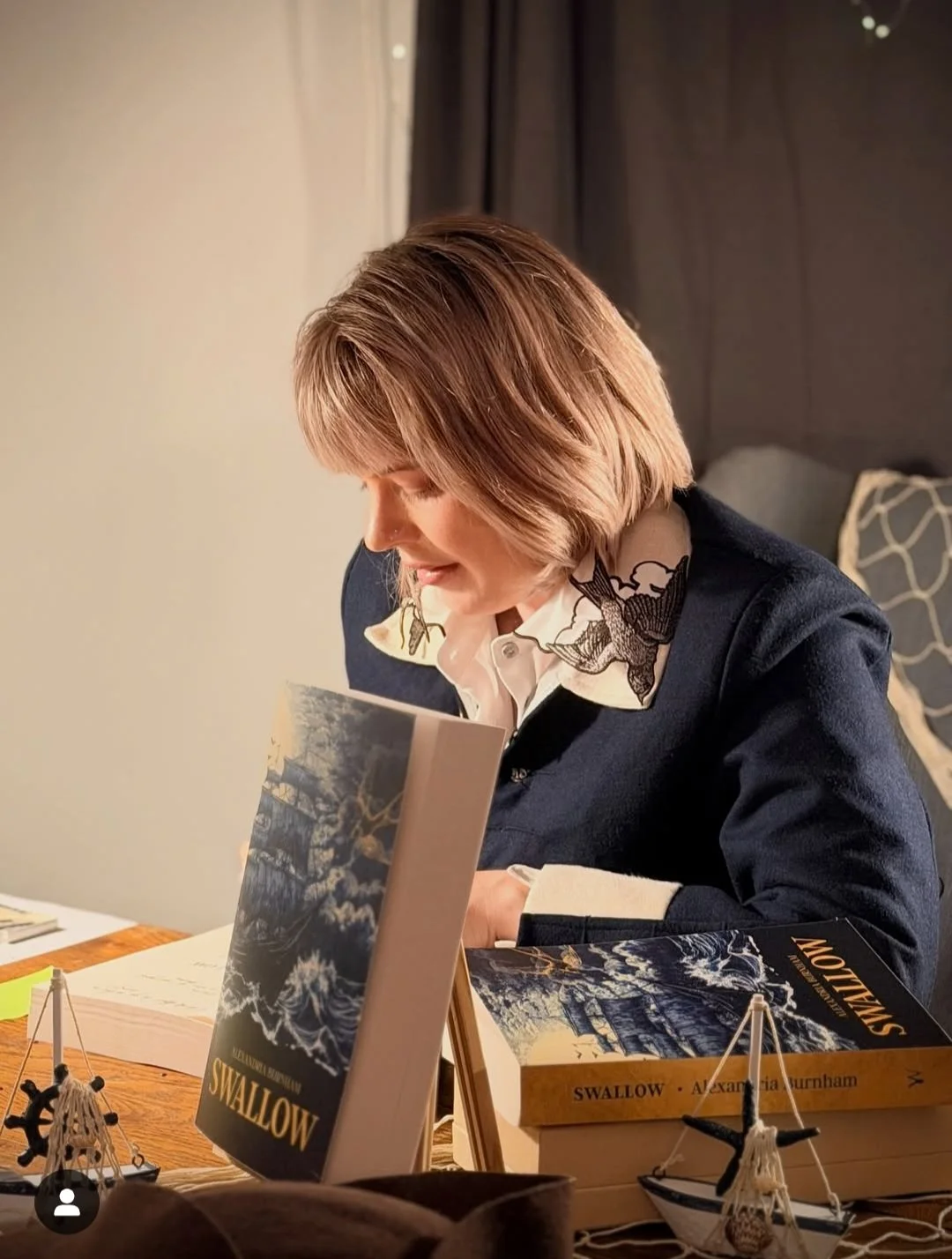
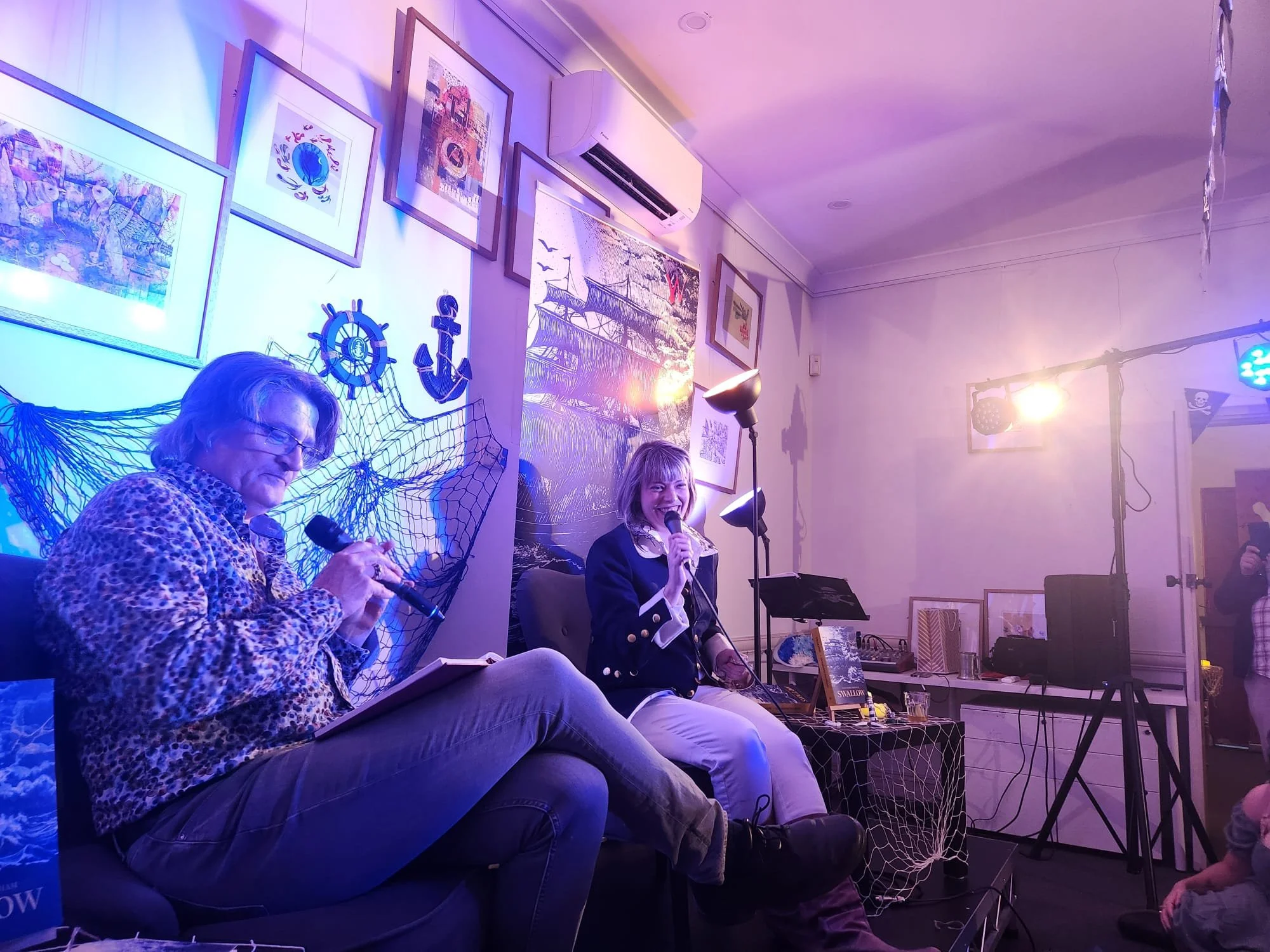
Interview with Alexandria Burnham - author of 'Swallow'

Alexandria Burnham is an AWGIE award-winning screenwriter, novelist and writer of comics. A NIDA graduate (2016, Masters, Writing for Performance), she is best known for her feature film Unsound (Apple, 2020), which was nominated for best original feature at the 2020 AWGIE (Australian Writers Guild) awards. A romantic-drama, the film won best Australian feature at the 2020 Melbourne Queer Film Festival and best fiction feature film at the 2020 ATOM Awards.

Ally is also the lead writer for Metropius (2021), a multi-media story world told across animation, comic books and board games, produced by 18 Degrees. Her screenplay won Most Outstanding Animation at the 2022 AWGIE Awards. Her comic book series, Forgotten Rose, is set in the same universe. When there is time, she also teaches at NIDA Open, course designing and training school-aged and adult students in screenwriting for film and television. She is also featured regularly on the writing podcast Prose and Cons.

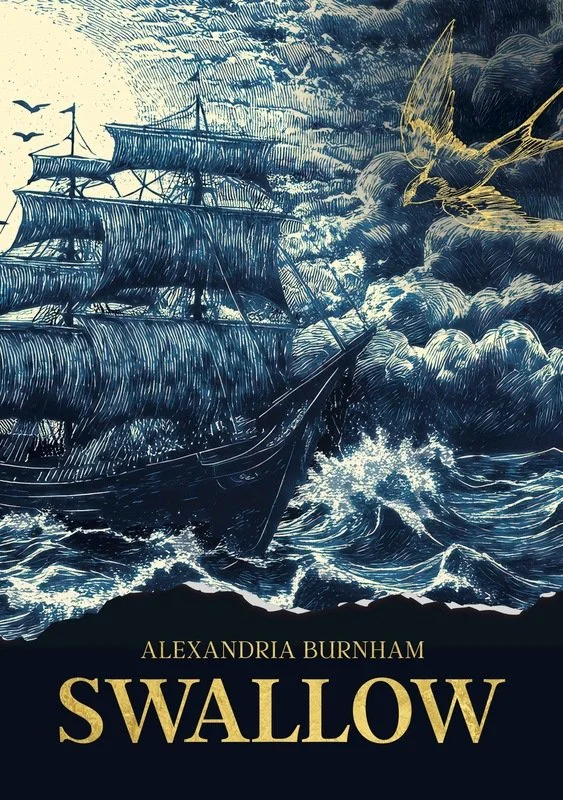
Alexandria’s new novel ‘Swallow’ is out now! See my review here.


📚

Interview with Alexandria Burnham

Please share what sparked the idea of writing Swallow and how long did it take to complete this mammoth story about a real figure in Australian history?

Roughly six years ago, an article about Swallow popped up online – news about Nick Russell’s discoveries in Japan, relating to the Cyprus mutiny and William Swallow. An Australian Pirate? I’d never heard of him before, and I fell down a rabbit-hole reading everything there was to know about him! I was captivated by the type of person he must have been, the dangerous and insane feats of escape he pulled-off, and the heartbreakingly romantic reasons why he did what he did.

It was shocking to learn that there wasn’t any fiction based on him! I wanted to know more about him—asking myself—what makes a man like that tick?  A very dangerous question for a writer to ask themselves. Once I fell down that slippery slope … the only way to get to know him better was to write him.

Describe William in a couple paragraphs: his vices and virtues. He was a man of many contradictions. Also, feel free to share any information on the people that mattered to him and how they helped/hindered his path to freedom or adventure.

I think what makes William such a great character is that he is simultaneously the sum of many different traits, both good and ill. He is brave; clever but not wise; a dreamer who refuses to be crushed by the systems of oppression he faces in his time and place; a rebel against authority.

He’s a romantic fool: to live to love is to be so full of life, and yet he always seems on the brink of death. That is a fun dramatic tension to play with as a writer. He is a maker of his own problems. But is someone to solve situations with words, not violence. As a result, we know he must have been charismatic; his black humour is easy to tease from his dire circumstances. He is resourceful, but prone to temptation—how else to explain how he keeps making the same mistakes?

Were there any difficulties in gathering research for Swallow? What became your favourite source? How much (percentage) of your story is fact and how much was left to your imagination to fill in the gaps of missing historical details?

My goal from the beginning was to be as true to history as possible, only tweaking for narrative pace and tension when absolutely necessary.  

Warwick Hirst’s The Man Who Stole the Cyprus has become my bible. When I first began researching, I reached out to Warwick and he generously sent me photocopies of all the newspaper clipping and court transcripts he’d collected. I have this beautiful orange folder I still go back and flick through to look up details. Reading through his research helped create my timeline of events – what William did and when. This timeline, I then draped over the rise and fall of story structure, finding the high and low moments to tease out. If there wasn’t a low moment in quite the right spot, or I was missing a ‘trigger’ to shape William’s emotional arc, I would ‘create’ into those gaps.

William’s interiority is truly where the inventing happens: we can know what he did, but history can’t tell us why. We can only speculate. To work out what pushes someone to those extremes. Those pushes become the plot! If we know something to be true – Wiliam definitely did this – I will go out of my way to massage it into the story one way or another. The challenge is making it all work and feel effortless – reverse-engineer it into a character driven story. So it reads as if its William making these choices, not history.

Did you take any expeditions or Odysseys of your own to get a sense of William’s life and times? If so, please share how it impacted your writing of Swallow.

I started writing during lockdown. As a result, while writing the early drafts, I wasn’t able to get myself to Tasmania and re-trace William’s steps. I was finally able to travel there in early 2024, before the final submission of the manuscript to my publisher.

I jumped in the water both at Recherche Bay – the site of the Cyprus mutiny – and stayed several days at Pirate’s Bay, named after William and John’s piratical seizure of the Seaflower sloop. Swimming in Pirate’s Bay is a dearly cherished memory – all the sensory details of those experiences, the colours, the smells, the texture of the sand, water, air, trees – I put all the details into the final draft. Hobart, too, features at the start of the book, and the way Hobart is today, it’s still quite easy to imagine how it used to be in the 1800s.

Port Arthur doesn’t feature in the series until the third and final book, but I travelled there to give my wishes to William. He’s buried on the Isle of the Dead, and I was sure to leave him flowers.

In preparation for the second book, I have recently returned from Japan – visiting Mugi, Tokushima, and Teba Island. I met with local researchers, and even spoke to a descendent of one of the real-life Samurai who met William and his crew – this Samurai will appear as a character in the sequel. There is even a Pirate’s café and hostel on Teba Island, named after William and the Cyprus!

It felt incredibly important to experience the sensory details of Mugi Bay, to understand how this body of water is different to all the other bays in the story. Writing a pirate book, you learn very quickly you’ll be describing lots of water and many different bays, and they all need to be described in a different way! But it helps that they truly do have different ‘vibes’ and personalities. It’s about capturing that, so if someone visits Mugi or Recherche, they too will get a sense that these two parts of the world are not alike at all.

The scenes in your novel are well described with rollicking action and stunning visuals: often what you’d expect in a modern movie. Would you agree your scriptwriting background has helped in your story telling of a bigger than life character, and how so?

Thank you! This is common feedback I receive, that my work often feels like reading a movie. Nothing intentional on my part – I started out writing for film and television, and by this point, I can’t really escape the habits and style of the way I was trained. I’ve always had a taste for ‘high budget’ and ‘big concept’ stories, so that likely feeds it too. I’ve learned to embrace it as a part of my style. Certainty, I am a ‘plotter’ with a natural urge to structure, and plan, and play with palm cards, all before I start writing. That’s a TV habit for sure. Dialogue, too, comes rather naturally, more naturally than other craft tools.

Though, for a long time there, when I was first stepping sideways into prose and writing novels, there were a lot of ‘bad’ screenwriting habits I had to unlearn in order to write a book. I was terrible at interiority – because you don’t put a character’s thoughts into a screenplay! I was bad at the finer details, the hem of someone’s shirt or the exact degree of pimples on someone’s face – all that stuff was usually up to costuming and make up, not the writer! Eventually, I learned a novelist has to be all the film departments at once, to make all those granular decisions, and put them on the page. Those details are in fact a novel’s greatest strength, and I learned to use those tools, and lean into them. Not to mention that screenplays are written in third-person, and I essentially used Swallow to teach myself how to write first-person.

Saying Swallow reads like a movie is a compliment and I will take it as one! But a part of me always says: yes but, does it read like a book? It’s a very different medium with its own demands and priorities (and word count!). I think a lot of novelists are in awe of screenwriters, not knowing that a lot of screenwriters are in awe of what novelists do!

If your novel became a movie or series (we can dream!) which actors and actresses would you love to see cast in the main characters’ roles?

I really struggle to answer this question! In TV, speculative casting is done all the time, even in writers’ rooms. I’ve never been good at picking answers! It’s not part of my writing ‘process’ to picture the characters as real people … if they are too similar to a real person, that real person starts to bleed in … and change them … then it’s all too messy.  

If absolutely pressed to answer, there has always, perhaps, been a young Mel Gibson to William. My husband is a big fan of Emily Blunt for Susannah.

What main theme or message runs through Swallow that you hope readers grasp in their reading of it?

I always discover my theme late in the drafting process. Draft-after-draft I’ll work on plot, characters, world-building, everything. And only once it’s all there, can I really take a step back and ask myself, ‘okay, what am I on about? What connects this all together?’ It’s a crucial part of the writing process, it can’t be skipped. I just know I tend to do it late, and a project isn’t finished until I solve it.

With Swallow, I asked myself what this story of running away from punishment was about. A literal escaping of the law. And see, how odd, why do I have this sort of love triangle in the middle of it? What does that have to do with this convict story about escape? What do John and Susie’s philosophies have to do with William’s choices aboard the Cyprus

It's always obvious in hindsight, of course. William is the centrepiece of a story about refusing to be bound, confided, judged, restrained, in any aspect of life. Whether that is being punished for trying to feed his family, William’s resentment of his social class, loving his wife but feeling trapped by a normal life on land, to John, and those who’d judge him for who he is attracted to. William’s nature is the cause of much of the plot: his restlessness, his pride, his stubbornness. And at every step, William is trying to reconcile who he is with his circumstances, or escape them. Once I cracked that, it was simply a matter of doing another draft, and making it seem like I’d known all of that from the start!

I hope readers connect with, what I think is a very human urge: to not be caged, by whatever aspect of society has them chained. I think it’s a way of making this historical fiction feel very relevant to readers now. It’s something people experience both 200 years ago, and today.

Please tell us about your writing background. Include your journey to publication.

Writing was always on the cards – I did a three-year Bachelor in Film and Screen Media at Griffith Film School. I always enjoyed writing, but wanted to see if I’d fall in love with any other film department. I worked a lot of jobs on film sets in Brisbane, but amongst it all, still wanted to pursue writing. I applied, and wonderfully, was accepted into NIDA’s Masters of Writing for Performance, and continued to develop my screenwriting. After graduating, I freelanced for five years, everything from script editing, developing outlines, treatments, pitch decks, TV writers’ rooms, and writing itself. Metropius has been a big on-going project, developing the series outline and bible, providing content for the games, and writing the comics. I’m quite proud the Metropius animated short film, that was the screenplay that picked up my AWGIE award! Unsound was my debut feature film, it premiered at the Sydney Mardi Gras Film Festival in 2020. It was after Unsound that I started looking for the next big project to sink my teeth into, and it was around that time I first read about William Swallow.

I have a fairly a-typical publishing journey. I spent a little bit of time in the query trenches, but probably not as much time as I’d recommend emerging writers should. I got a couple of full-read requests, that turned into ‘no thank yous’, but with pretty decent feedback. The feedback told me a lot about the market, and who might be the readership for this book. The biggest take-away being that Swallow’s ultimate home was going to be with an indie-press. An historical fiction trilogy is not commonly done! It was around this time I discovered WestWords, and the WestWords emerging writers’  pathway. The WestWords community means a lot to me, and I really resonate with the ethos behind a non-for-profit publisher – that all book sales get funnelled back into taking a chance on the next emerging writer. Also, Swallow became the best it could be, thanks to the sharp and keen editorial it received from publisher Michael Campbell.

Who would you say encouraged you the most in your creative development? Was there a course, special book or author that/who inspired you to become a writer?

There’s been a series of key people, across different project, and at different stages. Chyrssy Tinter was my screenplay editor for both Unsound and Metropius. She taught me a lot of the business, and how to handle feedback in a professional setting. She helped me through my first professional ‘trials-by-fire’, and I’ll be endlessly grateful to her.

I wouldn’t have written the first draft of my first prose manuscript (now a bottom drawer manuscript, but I’ll come back to it one day!) without Emily Maguire’s Year of the Novel at Writing NSW. Also, The Open Genre Writing Group at Writing NSW was pivotal for me, both motivating me to keep on writing, and a fantastic place to receive feedback. I made life-long friends from that group, who turned into Precipice Fiction. We wrote an anthology together, and now we produce a writing podcast called Prose and Cons. I deeply respect my fellow Precipites, their skills and knowledge, and their support and encouragement.   

As for authors that inspire me, specifically for Swallow, Scott Lynch, Patrick Rothfuss, and Hilary Mantel are my three touch stones. Whenever I need to hone Swallow’s voice, or motivate my prose, those are the three I turn to.
Name 4 books of 2025 that you loved and would recommend to your readers.

Everyone should absolutely check out novels from my fellow #DebutCrew2025 writers. Half-Truth by Nadia Mahjouri, Daughters of Batavia by Stefanie Koens, By Her Hand by Marion Taffe, and Sing to Me by Jelena Curic.

If you could time travel and meet one person in history, who would it be and what three questions would you ask them?

I have the world’s easiest answer to this. I’ve got two more William Swallow books to write, so chatting to him would be a big help. Beyond making him to detail his entire life’s journey, where his was when and what he did, I’d ask about Susannah, I’d ask about his childhood. Most of all, I’d ask about his dreams and his regrets. I’d ask how he’d want to be remembered.

I understand you have another ‘Swallow’ novel in the works. Can you share a bit about it?

Absolutely! Swallow is the first in a trilogy. His entire life story truly is that action-packed. For all my love of structuring, I simply couldn’t find a way to do it justice as a stand-alone. (And believe me, I tried).

It helps that there are three key locations along the Cyprus journey that make for the perfect trilogy: the mutiny in Tasmania (book 1), first-contact with sakoku, ‘closed-borders’ Japan (book 2), and the fall-out of returning to England (book 3).

I’ve began writing the first draft of book 2, and it has a working title, but no idea if the publisher will let it stick! We’ll find out together. I’ve committed to two-year cycles – aiming to release Book 2 in 2027, and Book 3 in 2029.

Celebrating the release of the final book in 2029 will be perfect, as it will mark the 200-year anniversary of the Cyprus mutiny: August 14th, 1829.

⚓️

Huge thanks to Alexandria Burnham for being my guest author this month! I encourage everyone to pick up a copy or two of her new riveting Historical fiction novel ‘Swallow’ out now as I guarantee you will love it!

Also, drop by Alexandria’s website to read more fascinating facts and writing info. Plus you can find links there to her social media pages and email.

Cindy L Spear