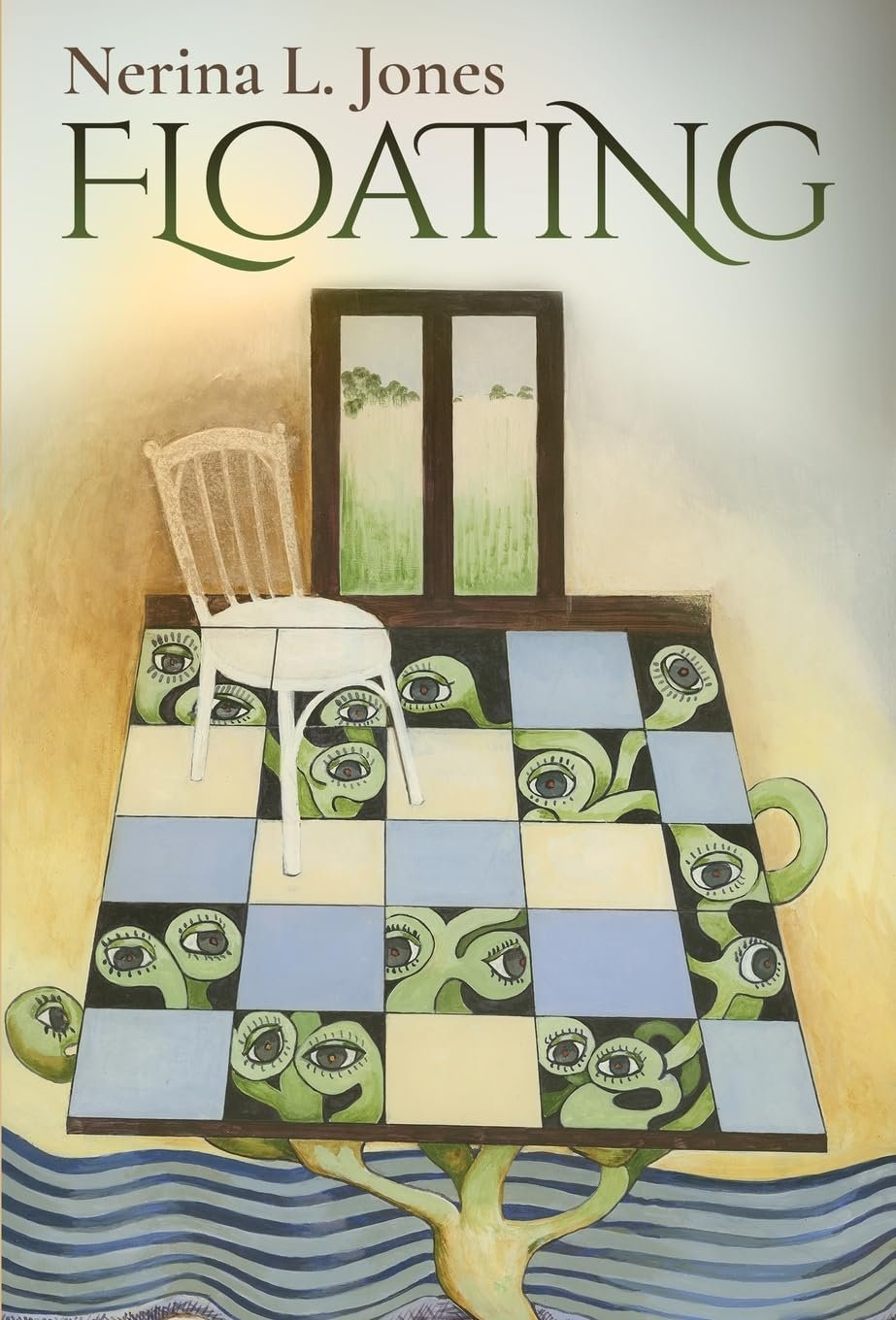
Review of Floating by Nerina L Jones
Release date: October 15, 2026
Publisher: Other Terrain Press
REVIEW
Floating by Nerina L Jones is an impressive debut literary fiction with of touch a magical realism. This novel is a deeply moving story about resisting ageism, obsoletism and prejudice. It sings of sisterhood, resilience and courage. And holds firm in the midst of deeper anxieties a human faces. Like a slug (frequent symbol and creature mentioned in this story) without a shell we are vulnerable to the world’s changing climate and viewpoints and often encounter isolation, social rejection and health issues as a result. We see these difficulties experienced by various characters in the story. And how death of marriages, death of friends and family can upend and individual’s stability and force change.
The story starts in the 1980s with forty year old Nanette (Nan) Marigold Pollo who leaves her husband due to his unfaithfulness. This is the catalyst for a big change in her life forcing her out into an unstable environment where she must create stability for herself and later her younger sister. She moves into a bedsit in Greysands, a suburb of Floating City. Yes, this is a strange name but the town’s foundation of fluctuating sludge that increases and recedes with the seasons, reflects on or symbolises something deeper in the novel: shifting reality.
Three women are important to this story. The first being Nan, a deeply resourceful, determined protagonist fighting to build a future on her own terms amid a gender bias tech boom. We also get major glimpses of Heather, Nan’s younger sister, and their relationship. Nan feels a deep, protective responsibility toward her. Heather goes through some unnerving changes once exposed to social media and Nan tries to help her. Then there is Sheila, Nan’s steadfast friend, who offers her much needed emotional support when the harsh realities of work-life become overwhelming.
This novel focuses on the digital world, the onset of the computer era that brings a lot of changes. One for Nan is the loss of her filing job in the government. She refuses to become obsolete and enrols in a computer programming course where she is the only woman and the oldest student there. She receives some flack by the male students but she presses on. And teaches herself to do code while working any job she can find to support herself. Her journey is a tough one. And we cannot help but feel empathy with all she encounters and endures.
The slug is a symbol of moral decay and a creature often mentioned in the novel and in classic literature. When Nan is contemplating the direction she has taken in becoming a computer programmer ‘blindly following the promptings of an emerging culture whose controlling power I neither foresaw nor understood…’ she wonders: would she have gone that route if she knew then, what she knows now? What she says afterwards is quite a graphic picture and metaphorical expression of burnout—thoroughly used up and swallowed by a situation. ‘I have been consumed in the belly of the slug and my dried out remains have been evacuated through the hole in its head.’ She is drained of spirit and discarded like waste. Not a pretty image for sure.
William Shakespeare frequently used the slug as a benchmark for sluggishness and delay such as in Richard III. Also the term "slugabed" used by the Nurse in Romeo and Juliet to describe someone who behaves like a slug by staying lazily in bed late into the morning, comes to mind. Virginia Woolf used slug images in her writings to represent sickness, vulnerability and repulsiveness. Their stickiness and unattractive behaviour does not conjure a friendly picture. A slug leaves a slimy trail (like they have been doing in my garden while devouring my bean plants)! But in a literary sense, these sticky trails parallel the human condition: as we pass through life, we collect a residue of ‘feelings, histories, and tensions’, leaving our own imprint on everyone we encounter.
We see Nan through decades of change and how various workplaces shape and reshape her life. She starts out being a student and ends with being a teacher. She is as resilient as the slugs surviving through hostile terrain. Nan has been dismissed and disadvantaged by an anti-female tech boom. This gap keeps widening—even today with generative AI. An article in the Guardian says: ‘women are largely excluded from the massive wealth and design choices of the tech revolution, while bearing the brunt of the digital harms, biased infrastructure, and the online safety risks it creates.” UN Women say: ‘Bias and discriminatory algorithms are not a glitch in AI - it is a pattern documented across systems at scale….AI models are trained on historical data, they often replicate and bake in decades of patriarchal bias.’ This is worrisome stuff and Nerina’s novel is a very accurate comment on the rapidly changing tech world and its negative effects on women. Nan is driven into gritty marginal spaces of society—from a confined Greysands’ bedsit to back-to-back library sessions booked under aliases—yet she refuses to break. Instead, she quietly moves forward, carving out a slow, deliberate path while adapting to her harsh new reality. Nan tries to avoid being swallowed up by the sledge of obsolescence.
Floating is an incredibly insightful story that makes some strong statements about the evolution of technology and how it affects people, particularly older ones. Plus, prejudice, ageism and misogyny are undeniably real. Floating gave me lots to ponder and left some strong images in my mind that I won’t forget. I definitely recommend reading this powerful, purposeful, and passionate debut. Its message is frighteningly true. 5 Stars ⭐️⭐️⭐️⭐️⭐️
Thanks to Nerina and her publisher for a review copy.