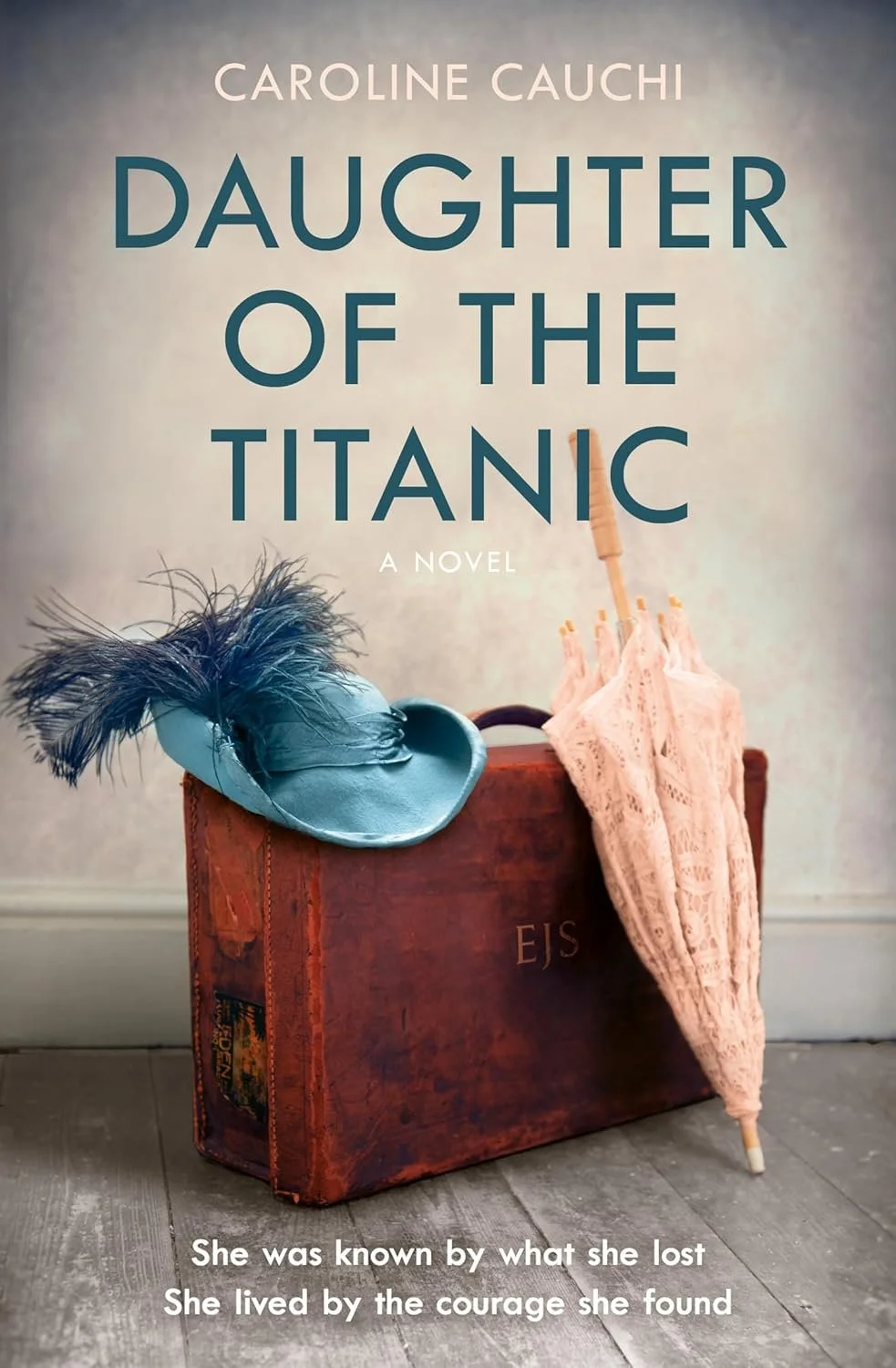
Review of the Daughter of the Titanic by Caroline Cauchi
Release date: April 1st, 2026
Publisher: One More Chapter (HarperCollins UK)
REVIEW
Press call them an unlucky family, an unlucky woman.
I have enjoyed immensely Caroline Cauchi’s previous novels about strong women that history forgot or marginalised. This time she focuses on Helen (Melville) – Mrs Russell Cooke, daughter of Captain Edward Smith of the fated Titanic. And what a revealing, powerful and moving portrayal it is! There have been many novels about the Titanic but I have never read any that focused on the Captain’s wife and daughter. Daughter of the Titanic certainly provided a lot of food for thought. We often see the leadership side of the Captain written about but never his role as a devoted father and husband. In Daughter of the Titanic we are given another perspective of seeing him from the viewpoint of his wife and daughter and how much they lost when the ship went down. In the aftermath of the tragedy, when the public and officials were looking for someone to blame, the Captain was depicted sometimes as reckless and other times as a hero. There was so much false information floating around, including some that fed into the hope he might still be alive but was in hiding. Grief can certainly play tricks on the mind and go against reason so it is understandable that Melville and her mother would secretly hope the Captain survived. Especially after reading letters and newspaper articles of those who thought they spotted him in various locations. This novel explores through his daughter and wife, what it must have been like to live through the trauma of not only the loss but also the endless savagery of media hype.
The novel is presented in two timelines from two women. One in 1972 with character Dr Catherine Hayes, who is writing a paper Luck, Legacy and the Female Image and seeks out Melville to provide her perspective from her experiences. The words below written by Dr. Catherine Hayes is basically the premise of her paper and the bones of this story that unveil through the telling of Melville’s life (in the second timeline of 1912 upwards).
Unlucky = cursed = burdened
Language = contagion
How myth attaches to women: how it refuses to let go.
Catherine is a University of Oxford history of art researcher. As noted, she is researching how ‘women are represented after catastrophe. How language and image…conspire to keep them there… Women end up as exhibits or … examples.’ Ideas spark to seek out Melville after she sees a painting of her. This woman has been labelled ‘Unlucky’. And as Catherine learns, the ‘unluckiness’ starts with the loss of Melville’s father on the Titanic. There is so much media coverage and finger-pointing and we see how these accusations affect the Captain’s wife and daughter. She is taught by her mother to keep appearances. Not show any cracks. Melville is frustrated by the public image and statue of her father that makes him seem cold and distant. But she argues with herself that they did not know him as a loving father and devoted husband. We relive those last moments through Melville’s memories before he left for the voyage that would end his life. And feel her and her mother’s sadness.
Catherine wants Melville to tell her side of the story—to give her viewpoint that proves her paper’s premise. To give the Captain’s daughter a chance to share the truth. And what it has been truly like for her and her mother. After a few letters Catherine manages to get a response from Melville and meets up with her. Their initial conversation is informative. And we hear how ‘Oxford was never built for women with opinions. Women’s voices are considered ‘decorative’ or ‘dangerous.’
Melville’s life is a series of tragedies. Some labelled her ‘an unlucky woman’ or said she was cursed. Catherine and Melville have something in common. And understand each other. Catherine can see that Melville never let herself be defined by other’s comments. She did not crotchet away her grief but ‘drove fast cars, flew planes, married badly. Played worse.’ She lived beyond the tragedy. Was human. Not perfect. Her determination, though, was admirable and she achieved much in a time when women received little recognition. And she deserved to be recognised for being more than just someone’s wife (as noted on her headstone). Which is what Catherine hoped to convey. And what the author wants to convey as well by writing this novel about Melville. That she become more than a footnote in history.
This novel is filled with exceptional poetic images and original analogies. I was inspired by Caroline’s gift of eloquent language and the beauty of its delivery. The prose is a rich and rare tapestry of insightful thoughts, clever humour, honest emotion, detailed perceptions, imaginative expressions and focussed plot directions. It is probably one of the most stunning, creative novels I have ever read. Its sheer magic held me spellbound and I could not stop reading until I had completed it in one day. And yes, I was up late chasing the pages to its conclusion.
This powerful portrayal delivered on all counts. Of how ‘women are framed - in portraiture as well as in the public record - and how these depictions can fix a life in place, rightly or wrongly.’ We see this through Melville’s account. I felt truly enlightened and blessed to have read this novel. Caroline has put not only clothes on a bare frame but filled in the missing ligaments and flesh. I felt I knew this woman by the end of the story and had great respect and admiration for her with all she endured. My heart broke for her over and over again, too, even though she never wanted anyone’s pity. But it was sad that her life was riddled with tragedy and messed up relationships. The different coping mechanisms people use are visible here. Even in her mother leading her to suppress her emotions (as she did herself) and put on a good front. Of course, it would be normal or expected behaviour in certain social circles and times. But at one point, Melville sets herself free— lets down her hair, exercises her grief on her own terms by finding outlets of expression in her car racing and plane flying, etc. allowing her to feel alive. Those moments of true freedom were priceless and left a lasting impression on me when shared in her life story with Catherine.
I will say no more because this novel needs to be read to be appreciated for all that it delivers and how beautifully it comes across. Daughter of the Titanic should not be missed. It is extra special and will leave your heart changed. This is an exceptional and haunting historical fiction treasure. In a league of its own.
5+ Stars
Thanks to One More Chapter and Netgalley for the ARC.