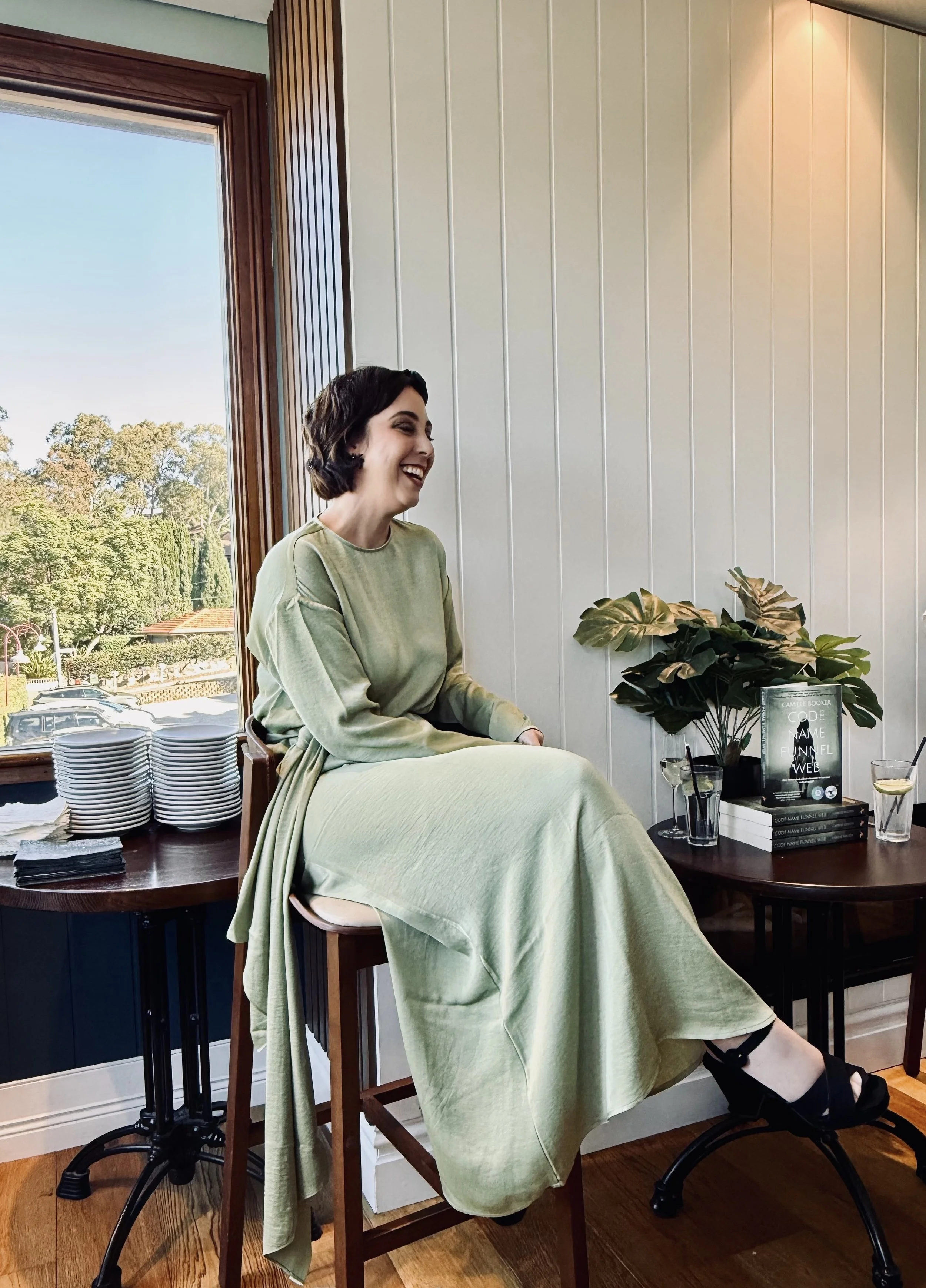
Interview with Camille Booker - Author of 'Code Name Funnel Web'
Interview with Camille Booker - Author of 'Code Name Funnel Web'
Review of novel here
About Camille Booker:
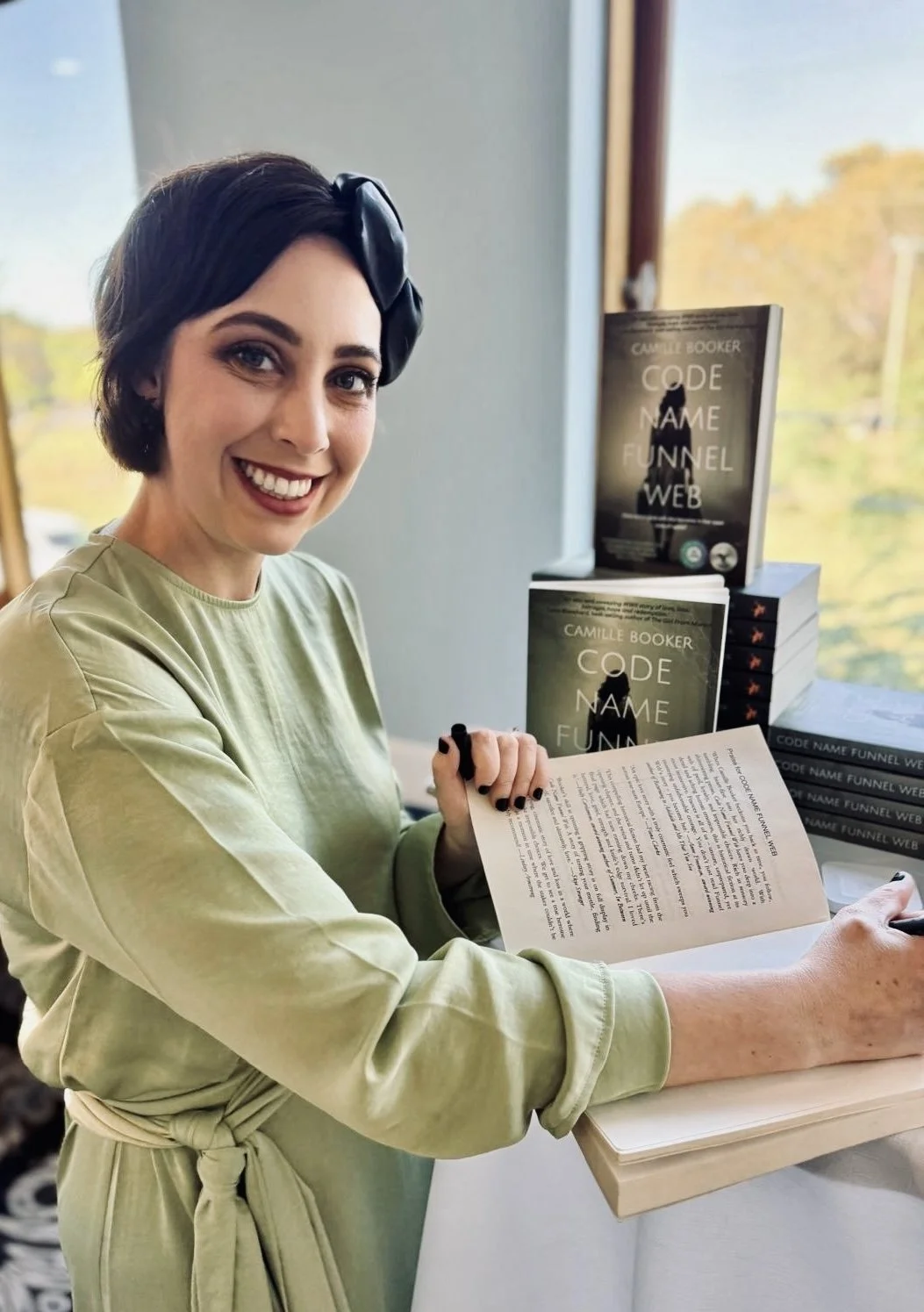
Camille is a multi-award-winning author with numerous accolades in writing competitions across Australia, the UK and the US. She is also an editor, teacher, PhD candidate, and literary judge for the Hawkeye Manuscript Development Prize. She has a bachelor's degree in creative writing, and is currently pursuing her PhD, also in creative writing, at the University of Wollongong.
🕸️
INTERVIEW
Tell us about the book, its inspiration, the history of its releases, and the story behind its title: Code Name Funnel Web.
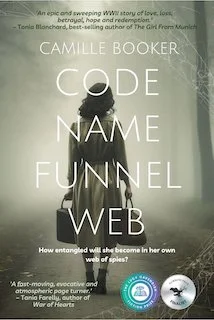
Code Name Funnel Web was inspired by the anecdotes and stories of my husbands’ grandparents, about what life was like during the war in our little suburb south of Sydney. A time when the ‘war in Europe’ felt far away, a time of unity, of resilience, of women stepping into the roles that their fathers and brothers left behind. I also read a biography on Nancy Wake (the Australian war heroine) and drew on her life and her courage and the incredible things she did for the Resistance. The funnel web is a recurring motif throughout the book (it appears on the very first page!) and through it I wanted to explore the parallels between the spider lurking in the dark and the deadly female spies of WWII who were also forced to hide in the shadows.
How important are the settings in this story? What part do they play in the plot’s development /movement?
Setting and place are always significant elements to my novels, not only in terms of plot development and narrative structure, but also for creating an immersive reading experience. This book opens in Como, a tiny but gorgeous leafy Sydney suburb nestled on the banks of the Georges River with fascinating (and little known) history, but then moves to London, Paris, Eastern Europe, the Soviet Union, and China. I wanted to explore the impacts of the Second World War in those far-reaching regions from a distinctly Australian lens. In my writing I always hope to transport the reader not only to the era in which the book is set, but to bring each setting alive through rich sensory descriptions. I want readers to taste the acrid smoke in the backs of their throats, to feel the slippery cobblestones beneath their feet as they run from danger.
Historical fiction requires extensive research. Did you take any special trips, utilise any particular works, or draw upon information passed down by friends/family? Name at least one discovery you learned in the process.
To immerse myself in the time period, I read a lot (mainly biographies but also fiction), and because I am a very visual person, I also watched a lot of WWII documentaries/films (there are so many!) and listened to music of the era. On the topic of music – there was one particular discovery that I found so fascinating I knew I needed to include it in my book.
When the United States entered the war, jazz was subject to a blanket ban because of its association with America. However, while foreign tunes were absolutely forbidden, Hitler did allow traditional music. The French took advantage of this and created an elaborate myth that jazz was a French creation. They wrote books to convince Hitler and the Vichy regime of the merits of French jazz, and composers’ names were altered to French ones. In the end, jazz looked as French as baguettes and brie. Their efforts paid off when the Nazis banned subversive “American swing” but permitted traditional “French jazz”. Of course, it was the same music, just cleverly repackaged.
Tell us about Frankie (Frances), who she was and how she became a Resistance agent. Was she modelled after anyone in history?
When the book opens, Frankie is a young woman living with her parents in Como, who feels unaffected by the ‘war in Europe’ – that is, until her beloved brother is sent to fight and soon goes MIA in Singapore. She falls in love with Leo, an Italian immigrant, but when he is detained as a POW, she travels to London hoping to discover the whereabouts of her missing brother, or if he is even still alive. While she’s there, she agrees to become a covert agent for the Resistance, code-named Funnel Web. Behind enemy lines, Frankie must survive Nazi-occupied Paris, gulag-infested Eastern Europe, and treachery-laden Asia with instructions to ensnare her targets by any means necessary.
I drew inspiration from three main real life WWII heroines: Nancy Wake (the Australian woman, nicknamed The White Mouse, who became an undercover agent for the SOE and was once the most wanted woman in France), Lee Miller (the war correspondent who captured photographs depicting the brutality of the war from the front lines), and Josephine Baker (the performer who used her fame, her beauty and her charm to fight against the Nazis in France, smuggling secrets to the Resistance hidden in her clothes).
But Frankie really is an acknowledgement of all of the women who played vital roles during the war – not only those who joined the SOE and the Resistance, but also the women who remained on the homefront, who did industrial and agricultural work, who drove ambulances, or who were involved in code breaking. Their unmatched courage, resilience, intelligence, and determination are so often overlooked, or overshadowed by men. Then, when the men returned from war, women were often forced to resume those traditional roles considered more suitable. However, the ingenuity, courage, and resilience that these women demonstrated during the war paved the way for the generations of Australian women that followed.
Describe each of these men in a few words and their connection to Frankie: Thomas, Leo, Christoph, Roger, Professor Atkins.
Thomas is her beloved older brother, her moral compass, and the reason she is determined to persist;
Leo is her first love, her true love, the one she cannot forget;
Christoph is her target: a high-ranking Nazi officer stationed in Paris, she must seduce him and report his secrets back to the Resistance;
Roger is her American contact, a fellow spy, and a friend;
Professor Atkins is tasked by Churchill to recruit young women (including Frankie) to the SOE. He convinces her to become a spy by suggesting he can help her find her brother’s location.
Your novel has been classified as Gothic Historical Fiction. What elements are present in Code Name Funnel Web that make this so?
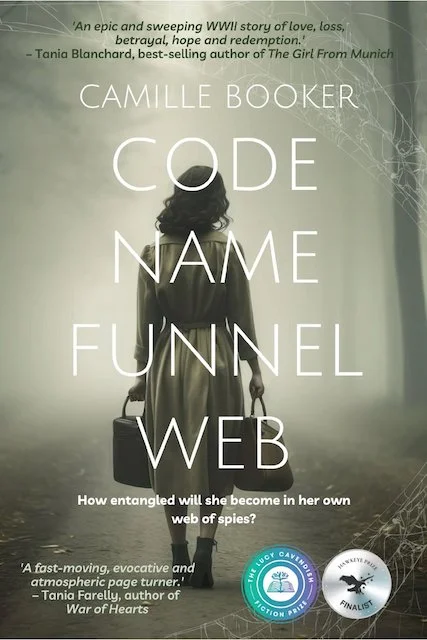
To me, gothic historical fiction is about striking imagery, lyrical prose and haunting metaphors, while imparting a feeling of dread or suspense. I’ve always loved gothic settings; atmospheric, moody scenes are so much fun to write because, as writers, we’re constantly forced to think: how do we want the reader to feel while they’re reading this? Horrified? Terrified? A sense of unease? Of biting their fingernails? Or will I allow them a little relief? Gothic historical fiction allows us to explore the murkier, hidden side of history, for example, (as was the case with Code Name Funnel Web), a time of darker moments in our past, of internment camps and the deep-seated fear of the ‘other’, as well as the choices women were forced to make during wartime. The recuring motif of the spider also adds a layer of gothic imagery that is a continuous thread throughout the book.
Please share about the WW2 internment camps in Australia and how you used this info in your story?
I underwent extensive research for each part of this book. but what resonated with me long after I finished writing was the darker moments in our own history, especially concerning Australian internment camps and our deep-seated fear of the ‘other’ at the time. Code Name Funnel Web gives an account of the suffering of the 4,700 Italian-Australians who were subjected to discrimination, open hostility and incarcerated in camps around Australia during that time. When simply being Italian was considered sufficient grounds for internment. In particular, fishermen received severe attention because their boats and seafaring experience could constitute a threat to national security since they could aid spies getting in and out of the country. Fishing boats belonging to Italians were confiscated, fishermen had their licenses suspended and many were interned. The book tells the story of one Italian-Australian, a boat-loving immigrant, amongst thousands of internees, detained at Cowra. His experience was common to many of the hard-working Italian immigrants who lived in Australia, trying to make a new life for themselves, when war and xenophobia changed their lives forever. Code Name Funnel Web provides insight into such experiences of these ‘enemy aliens’ during a period of international political conflict, a period of our wartime history that has been excluded in many Australian history books.
Which scene was the most difficult to write and why?
I left the most difficult scene to write until the very end – because I knew I needed to dig deep and I couldn’t afford to have any interruptions. There’s a scene towards the end of the novel where Frankie is forced to confront her past trauma. I think, when writing these types of triggering scenes, it’s important to explore the physical and the emotional impact from a deep point of view. When you draw on memories you’ve long since pushed down and here you are trying to dredge them back up so you can write about them in a compelling way, it’s psychologically draining and, afterwards, you feel quite vulnerable. The best remedy for recovery after writing these difficult scenes, I think, is to go outside for a walk in the sunshine, or a swim in the ocean.
Tell us about your publishing journey. Have you always wanted to be a writer? What or who inspired you to take this path?
I’ve always loved books, reading, and being swept up in a story, but I only started writing during my first year of teaching at a prestigious boys’ high school in Sydney, when (to avoid burnout) I needed a creative outlet. It was a really high-pressure job for my first teaching gig, and I was quite stressed, so I used to daydream about it throughout the day and then try and write on the commute. I put the manuscript in a drawer, and it remained unfinished for a long time. Then when I became a mum, writing was a way to take some time for myself. Something just for me.
When I completed the draft, I submitted it to some unpublished manuscript competitions. I had some success and some complete rejections, and then, finally, I found the Hawkeye competition. I never expected to be a finalist, but being runner up in their competition led to an offer for publication. Hawkeye is a boutique, trade publisher based in Brisbane.
If you could go back in time, what period would you want to visit and who would you want to meet? What two questions would you ask him/her?
It probably sounds cliché (especially as a writer), but I’ve always wanted to go to Paris in the 1920s. I’d probably be one of Hemingway’s groupies and follow him around the cafés, talking about writing and life while drinking copious amounts of wine and smoking with one of those very long and very glamourous cigarette holders.
What have you learned from your writing and publishing experience that you wish you knew earlier? What advice would you give your younger self?
Make a long list of all the competitions for unpublished manuscripts and apply to them all;
Be prepared to receive a lot of criticism on your book but don’t take it personally. If you are willing to be adaptable, and work with editors, you can usually find some middle ground;
Be prepared to do a lot of redrafts and edits;
Keep the principles of writing and craft in the back of your mind (such as plot development/turning points and character arcs), especially when writing in deep POV;
Remember, your story already exists inside you. If you sit down at the keyboard, the words will come.
Name three of your favourite novels published in the past year, that you would highly recommend. What is special about them?
Wild Dark Shore by Charlotte McConaghy (an atmospheric, contemporary, gothic cli/fi thriller);
Almost Life by Kiran Millwood-Hargrave (an all-consuming book set in Paris in the late 70s, about longing, the choices that define your life, and heartbreak);
What Is Left For Us by Sophie Stern (a compelling, emotionally-charged and character-driven story about two estranged sisters and the crumbling cliff top house in Bondi that bring them back together).
Do you have any new novels or projects in the works that you can share a little about?
I am currently pursuing my PhD in Creative Writing, and my thesis aims to explore how contemporary novels are embracing the figure of the witch to reveal power structures within society. So I am working on a witchy novel that is Australian gothic historical fiction with elements of magical realism and folk horror. It’s Hannah Kent’s Devotion meets The Craft (1996) with a Robert Eggers’s The Witch (2015) vibe.
🕸️ 🕸️ 🕸️ 🕸️ 🕸️