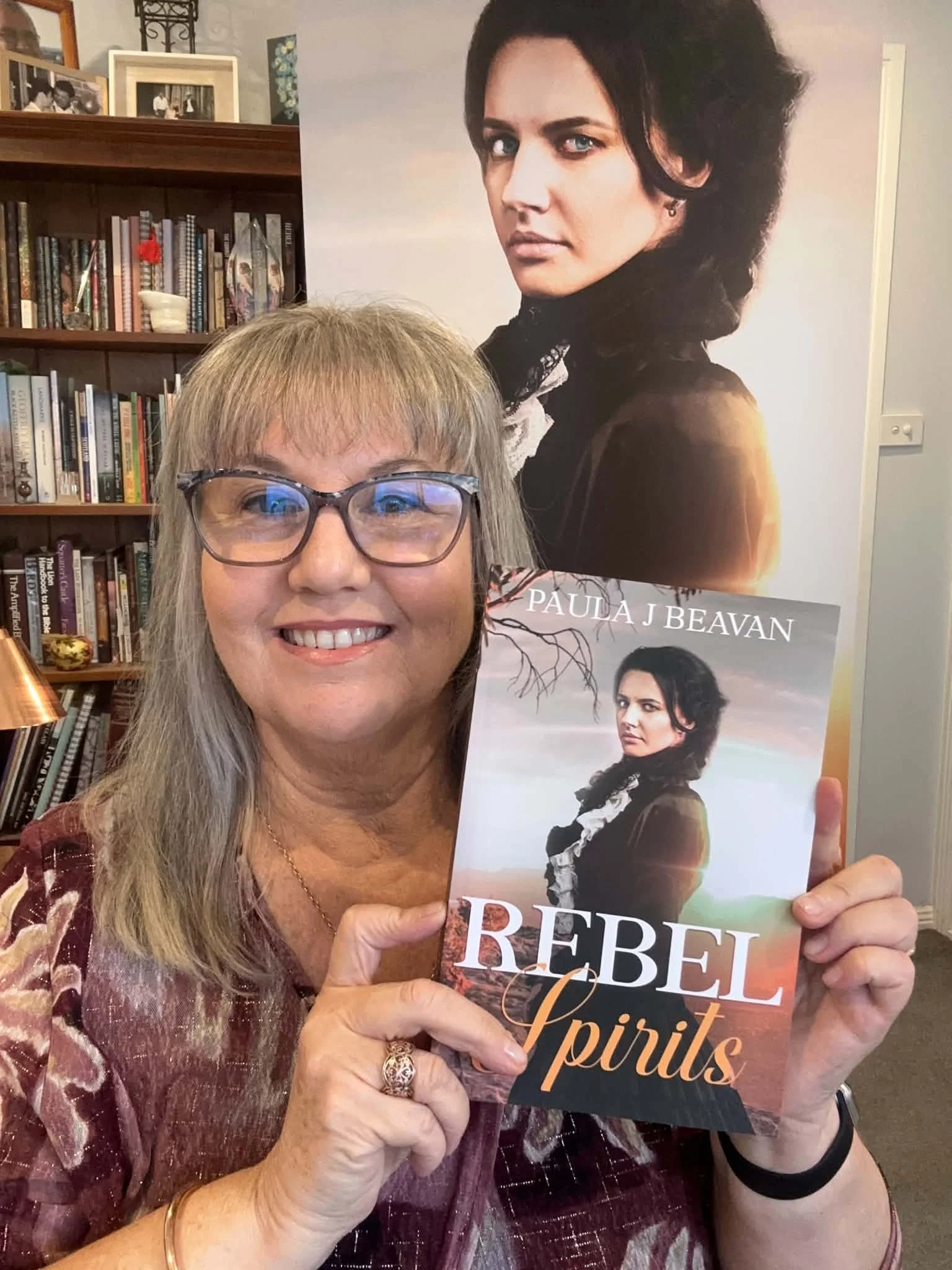
Interview with Paul J Beavan - Author of Rebel Spirits
Interview with Paul J Beavan - Author of Rebel Spirits
Novel is out now!
What is it about 19th Century Australia that inspired you to set Rebel Spirits in this time period?
The Hunter Valley, all of Australia, were in an era of massive change. It was a time of upheaval for the indigenous, but also the settlers and the convicts. It was a whole new world, and I find it interesting to delve into how people coped with those changes.
Please provide an overview of the story and the significance of the title?
In colonial Australia’s Hunter Valley, Irish immigrant Ellen Maguire is struggling to save her family’s failing inn. Desperate, she turns to distilling illegal poteen from her grandmother’s remedy book—a dangerous venture that draws the attention of criminals and the colonial authorities alike. When injured Englishman Jack Bell arrives searching for his missing niece, attraction grows between them, but Ellen’s secrets threaten everything she’s fighting to protect. As danger closes in and long-buried truths emerge, Ellen must choose between safeguarding her family and risking all for love.
As for the significance of the title, it reflects both the characters and the sly-grog trade at the heart of the story. Ellen is rebelling not only against the law, but also against her own conscience and upbringing. She has a rebellious spirit of her own, while quite literally brewing spirits to save her family’s future.
There are many Irish references in the novel: the Harp and Hound, Irish music and instruments such as violin, whistles and bodhran and the Maguire family, of course! Why did you choose your main family to be Irish? Do you have Irish heritage?
I do have Irish heritage, and I have some great friends who are Irish, so I think that was a contributing factor. But mostly when I first imagined Ellen contending with her father’s grief, I just knew Paddy was Irish, so that decision pretty much set the scene.
What two historical facts did you uncover during the research stage that surprised you and led you to use these discoveries in your story?
There were quite a few surprising discoveries during my research. One was learning that llamas and alpacas were actually brought to Australia during the nineteenth century, something I only discovered shortly before I began writing Rebel Spirits.
Another was just how widespread and dangerous sly grog shops were in colonial Australia. Some of the alcohol being sold was incredibly poor quality, and in some cases even deadly. That discovery really shaped the atmosphere of the story and helped raise the stakes surrounding Ellen’s involvement in the illicit spirits trade.
Tell us about Ellen Maguire, Jack Bell, Michael Maguire, Paddy Maguire, Mrs. Reid and Elizabeth in a couple lines each.
Ellen is careful and responsible, but she’s sort of that way because of circumstance. I think her fun and rebellious nature shines through when she starts producing poteen.
Jack is in the colony on a mission, to find a niece he’s never met and fulfil a promise to his sister. He’s kind, compassionate, and an effortless hero. He’s not trying to impress anyone; he just does what he sees as right.
Michael is a larrikin, and while his methods are often questionable and far from well considered, he is genuinely trying to help Ellen save the inn from financial ruin.
Paddy is simply grief-stricken. His wife was the heart of the Maguire family, and after her death he lost himself in drink. But beneath it all, he’s a good man, and it was rewarding to see him find a measure of redemption over the course of the story.
Mrs Reid is a feisty Irish-Catholic woman with a heart of corn, as she would say. Widowed and having lost all her own family, she finds a new sense of belonging with the Maguires. She becomes part of their makeshift family—and very much has her eye on Paddy.
Elizabeth is a lost soul. Life has worn down the once free-spirited girl, and she is now in survival mode. She has become as hard as she needs to be, willing to do whatever she believes is necessary to get by.
What was your favourite scene to write and what was special about the experience?
I think the scene in the creek with Ellen and Jack wrestling. It was fun because I could just see it, and my fingers were hardly able to keep up as I tried to get it written. I love it when writing is like watching a movie play out in my mind, but it was really hard to edit it, as I loved the frenzy of the scene, but it was pretty messy, so it was difficult to fine tune it without losing the energy of the moment. And I don’t really know if I managed it.
What theme(s) in this novel echo(es) of issues we face today?
Resilience is the first thing that comes to mind. And the echoes, well we’re living in a world of changes, and hard times, financial instability, and yet life goes on, we’re still muddling along, doing what we need to, falling in love.
Have you always wanted to be a writer? And what or who sparked this interest?
I started reading quite early, before I even went to school. My grandmother was always reading, and I used to lie on her bed with the sun shining through the windows while she read her Mills & Boon novels aloud to me. Books have always been tied to happiness for me.
I don’t remember ever consciously deciding to write; it just seemed to be something I always did. I always had a notebook close by, and my strongest subjects at school were English and history in high school, and “composition” in primary school.
Please tell us a bit about your journey to publication and your proudest moment.
My journey to publication was embarrassingly easy. I’d submitted one YA book to a publisher slush pile, and although it was rejected, I got fabulous feedback. Then a friend you may have heard of–Tea Cooper—asked me what I was doing with my Australian historical, and she suggested I should polish it and send it to Harlequin at Harper Collins, so I did, and got an email within two weeks. I’d spent the intervening ten years between the first awful draft and getting a publishing deal, writing new books, but didn’t submit during that time. I felt like I needed to do my apprenticeship. I also did a lot of writing courses.
Name four of your favourite historical fiction authors and one of their books you love.
Well, Tea Cooper of course, and my favourite of hers is The Butterfly Collector. Darry Fraser is another favourite, but I only read hers after my books had been compared to hers, and my favourite of hers is The Prodigal Sister. Catherine Jinks is fabulous and her Shepherd is unputdownable. Kate Forsyth is another, and her book The Blue Rose is sublime. It’s really hard to stop at four.
If you could time travel to the past, what year would you visit, what location and what historical person would you like to meet.
I’m fascinated by ordinary people who endured extraordinary hardship in colonial Australia, so I think I’d most like to meet someone like Caroline Chisholm, who worked with immigrant families trying to build new lives in an unforgiving environment. Those are the kinds of untold human stories that inspire my writing.
Are you working on a new writing project and can you share a little about it?
I’m currently working on a new cosy mystery series set in the Hunter Valley called The Shelby Estate Mysteries. The first book, Romantics Anonymous, is quite a different direction from Rebel Spirits, blending mystery, romance, humour, and small-town intrigue, but it’s still deeply connected to the same world.
The series is set at Shelby Estate, featuring the homestead featured in Daughter of the Hunter Valley, so readers will still find that strong sense of place and layered history that I love writing about. A friend described it as a legacy world, and I think that fits perfectly. While Rebel Spirits explores the hardships and dangers of colonial Australia, the new series shifts into contemporary cosy mystery, following twin sisters Jasmine Sheldon and Rose Coulter as they navigate family secrets, community drama, and amateur sleuthing in the Hunter Valley.
I’ve really enjoyed exploring a lighter, more romantic tone while still keeping the emotional depth and atmosphere that inspired my earlier stories.
Here’s the pitch:
Polar-opposite twins join forces to run slow-speed dating weekends in their historic home, but when a valuable diamond necklace goes missing, their first event may be their last.
But, I also have an idea (AKA millions of sticky notes) for another historical story with an American cowboy, visiting the colony with a wild west show . . .
Thanks so much Paula for sharing your thoughts with us and for being our guest author today! I wish you much success on your new novel’s release and your exciting projects! Rebel Spirit is an amazing story that many will love as much as I did. For those who missed my review, here is the link.