Discuss the relationship dynamics between Caroline and her brothers William and Alex. How are they different and/or the same?
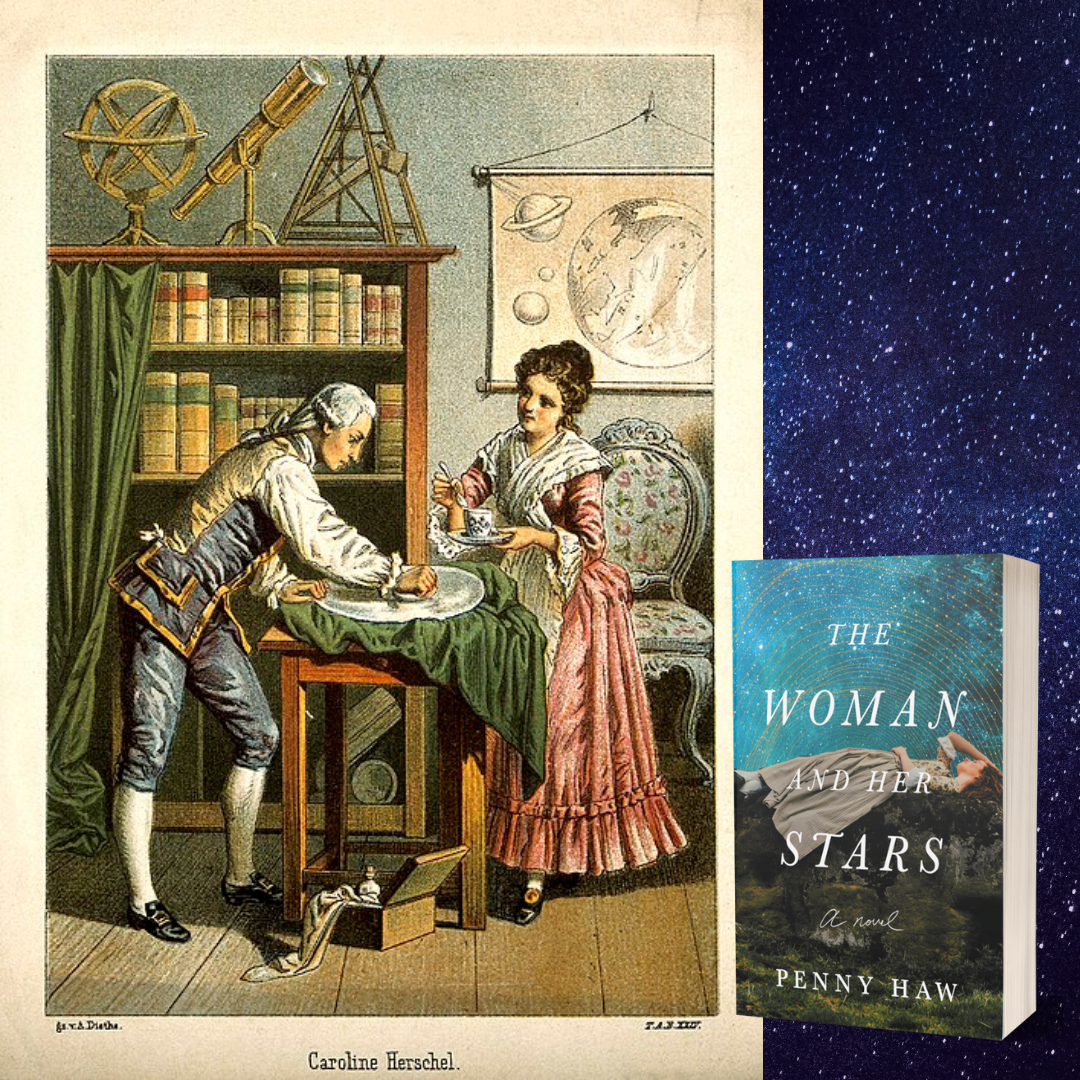
William was, by all accounts, a charismatic character. He fled Hanover to avoid conscription and became an esteemed musician and music teacher in England, finally assuming the role of music director of public concerts in Bath. He was handsome, popular, and intelligent and, when his fascination with the night sky led him to discover the planet Uranus, he was appointed King’s Astronomer by King George III. William rescued Caroline from servitude in Hanover, brought her to England, and gave her the education and interesting life she’d quietly yearned for. He was her hero! Alex was the quieter brother. He was earnest, down-to-earth and prone to melancholy. He was also a musician and, although not a star gazer, a skilled technician, who helped William and Caroline build telescopes. Caroline didn’t worship Alex the way she did William. However, when they moved to Datchet and faced many challenges and William was busy at court, she recognised Alex’s strengths and appreciated him anew. The brothers were the same in that they were quietly devoted to Caroline and intrigued by the astronomical technology of the day. However, William was consumed by his work and oblivious to Caroline’s adoration and her frustrations. Although she didn’t confide in Alex, he was sensitive to what she was experiencing, and candid and pragmatic in his advice; characteristics Caroline came to appreciate with time.
Describe these women with four words each: Caroline, Margaret, Mary, Miss Hudson.
Caroline: guarded, lonely, passionate, brilliant. Margaret: fragile, intuitive, generous, hapless. Mary: spirited, hopeful, devoted, forgiving. Miss Hudson: cunning, duplicitous, pushy, resentful.
What obstacles, social and personal, did Caroline (and other women) face in the 1700s?
Although receiving an education was a challenge for all females in the 1700s, Caroline was particularly disadvantaged in this regard. She was hungry to learn but, because her growth had been stunted by typhus and she was badly scarred from smallpox, her mother decided any education would be wasted on her. At the time, a little basic education for girls was deemed useful to ensure they married well. Caroline’s mother was certain no man would want her because of her disfigurements and thus decided she should receive no education. A woman’s worth was never considered beyond the support she could provide a man. Women were considered physically, intellectually and emotionally inferior, were treated as secondary citizens, and expected to produce children and take care of domestic matters. The nature of her childhood meant Caroline also faced social obstacles. Although her family was middleclass, she didn’t form relationships outside of her family in Hanover, where she was a servant. When William took her to Bath, where he educated and trained her to become as singer, she had to learn to interact with people belonging to various classes and to perform for audiences. I was intrigued by how this must’ve felt. Caroline was self-conscious about her appearance but sang beautifully and learned the ways of an English lady from Miss Fleming and Miss Hudson. Still, I wondered whether she felt at ease in their company or if her relationships with people like Mr. Corden and Hannah were more comfortable for her. Of course, once she became confident as an astronomer, she also had to adjust to being in the company of scientists, other learned men, and members of the nobility. That she was eventually able to navigate and thrive in such circles highlights what an extraordinary woman she was.